When I created Landly, the goal was to make a landscaping landing page that already had the right conversion flow: a strong hero, trust signals, visual proof, testimonials, FAQs, and a clear estimate form.
So when I wanted to turn it into a website for a fictional landscaping company, I didn’t want Framer AI to redesig
n everything.
The better approach was to keep the structure that already worked and make the business inside it feel completely different.
For this example, I customized Landly for Evergreen Outdoor Co., a residential landscaping company in Austin.
The Original Structure Was Already Strong
Landly already had the sections I wanted:
Hero → trust stats → benefits → transformations → process → testimonials → FAQ → estimate form
There was no reason to rebuild that flow.
Most of the customization happened in the content and visual identity instead.
I changed the copy, imagery, brand direction, services, calls to action, and business details. Those are the things that should almost always change when adapting a template.
The layout only changed where there was a good reason.
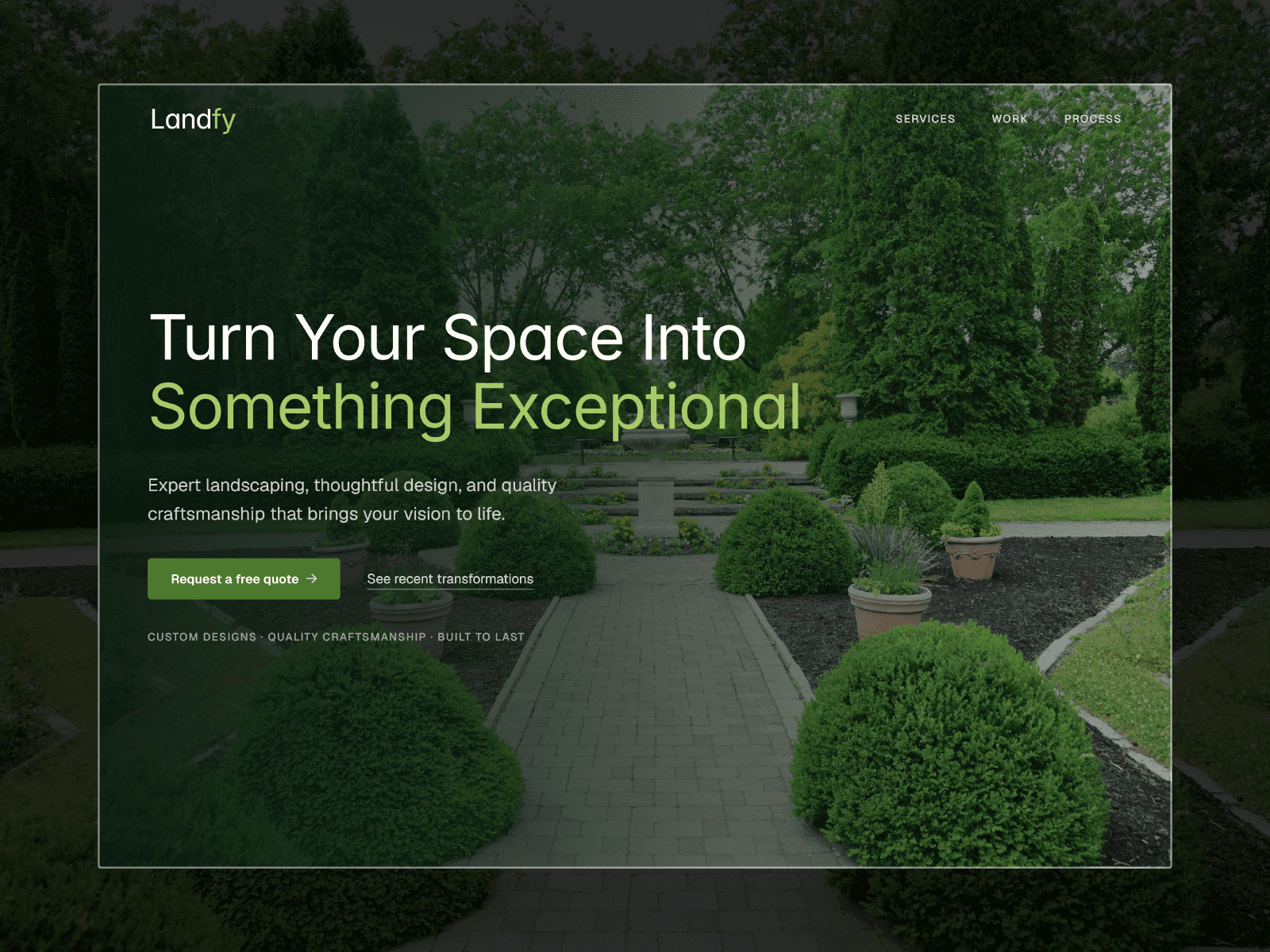
I Made the Hero More Specific
The original hero already had the right composition: large landscaping imagery, a clear headline, and two CTAs.
So I kept the layout.
What changed was the message.
Instead of generic landscaping language, the customized version became more specific to a residential landscaping company in Austin.
New direction
Turn Your Yard Into a Space You Love
Thoughtful landscape design and professional installation for homeowners across Austin.
Request a Free Estimate
View Our Work
The goal was not to make the hero look completely different.
It was to make it feel like it belonged to Evergreen Outdoor Co.
I Turned Generic Benefits Into Reasons to Trust the Company
The original template had four benefit cards.
That structure still made sense, so I kept it and changed the content:
Custom Designs for Your Home
Quality Materials and Plants
Clear Project Planning
Experienced Landscaping Team
This is a good example of where AI customization works well.
The component stays the same, but the meaning changes significantly.
For another business, I might reduce four cards to three, reorder them, or make one benefit more prominent. Those are useful layout changes because they support the content rather than changing the design just for the sake of it.
The Transformation Section Needed the Least Work
The before-and-after section was already one of the strongest parts of Landly.
For landscaping businesses, visual proof is much more persuasive than long service descriptions.
So instead of redesigning the section, I replaced the imagery and changed the project stories.
For example:
Overgrown Yard Renovation
An unused and overgrown area transformed into a cleaner landscape with defined planting and easier maintenance.
Modern Garden Makeover
An aging garden redesigned with stronger structure, layered planting, and a more contemporary feel.
The layout stayed almost identical.
The content made it relevant to the new company.
I Kept the Process Simple
The original three-step process also worked well, so I adapted it instead of adding more complexity.
01 — Request Your Estimate
Tell us what you want to improve.
02 — Design Your Landscape
We create a plan around your property, preferences, and budget.
03 — Build and Transform
The team brings the design to life.
This is another section where I would only change the layout if the business required it.
For example, a company with a longer consultation process might need four steps instead of three.
The Framer AI Prompt I Used
The prompt is at the bottom of this article.
What I Would Still Change Manually
AI can handle a lot of the first pass, but I wouldn't publish immediately.
I would still manually check:
headline wrapping
spacing
mobile layout
image cropping
CTA consistency
form fields
real business information
service accuracy
testimonials
statistics and claims
I would also replace generic imagery with real project photography whenever possible.
For a landscaping business, that alone can make the customized version feel dramatically different even when the underlying layout barely changes.
The Final Result
The interesting thing is that the final website can still look clearly related to Landly.
That's intentional.
The goal isn't:
template → completely different website
It's:
template → website that feels specific to a real business
The structure stays familiar.
The business identity changes.
And that is exactly where Framer AI is most useful: adapting a strong starting point instead of asking AI to reinvent the whole page.
Want to Try It With Landly?
Landly is a Framer landscaping template built around visual proof, trust, and estimate requests.
You can use the same customization approach above: replace the business, content, branding, and imagery first, then let AI make smaller structural adjustments only where they actually improve the page.
→ Get the Landly Framer Template

Share